Search

Some Nerd Girl

Some Like It Nerdy

Author

somenerdgirl

The Astrobiologist’s Guide to Life, the Solar System and Everything

As I’ve mentioned previously, my career is based around looking for alien life in the universe. Naturally, this brings up the very pertinent question of “Where exactly does one look for aliens?”

The answer, surprisingly, is “pretty much all over the place.” And with good reason – here on Earth, living organisms have been found in some of the most seemingly inhospitable places, which suggests that life is, above all, tenacious in the extreme.

Where to begin, then? Why not in our own backyard? As it turns out, there are more than a few places in our own Solar System that might harbor life. So, without further adieu, let’s take a guided tour of the Solar System’s hottest real estate, moving from the inner planets outwards.

Venus
Venus copy.png

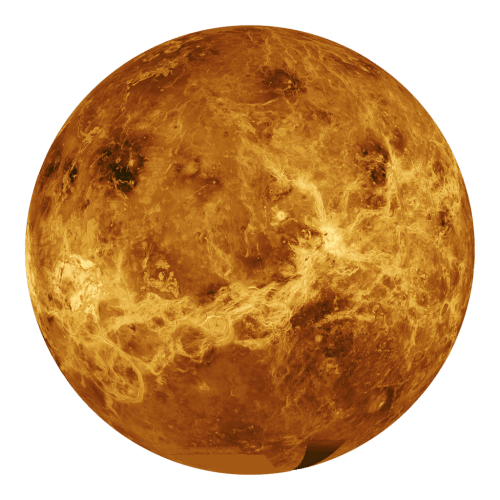
Venus may seem like a surprising candidate – the surface is hot enough to melt lead, the atmospheric pressure is crushing, and it rains sulfuric acid. But Venus was not always so grim. It is thought that it may have had oceans for the first two billion years of its history, before the growing intensity of the young sun triggered a runaway greenhouse effect that boiled them off. Life may have been able to get a toehold in these early seas, as it did on Earth.

But where could such life have fled to under the onslaught of rising temperatures? Curiously, it turns out that while the surface may be utterly inhabitable, at ~50km above the ground, the atmosphere of Venus is remarkably Earth-like in temperature and pressure. It’s still fairly acidic, there’s no oxygen, and it’s still on the warm side, but there are organisms on Earth that will quite happily live in similar conditions. UV radiation would be a problem – however, interestingly enough, cylcooctasulfate – a sulfur compound that absorbs UV rays and re-emits them as visible light, and that’s used by terrestrial microbes as “sun screen” – is found in the Venusian atmosphere at an altitude of 50km.

Earth

Earth.png

No, I’m not suggesting Earth’s been invaded – I’m instead referring to the idea of the shadow biosphere. The basic premise of the shadow biosphere is that we assume that all life on Earth is biochemically similar to us (e.g., it uses the same types of proteins and DNA, same chemical reactions, and so forth), and therefore we would fail to detect microbes that used radically different biochemistry. The microbes wouldn’t be “aliens”, per se, as it’s assumed that they would’ve evolved here on Earth – but such a finding would still be incredibly significant, as it would suggest that life may developed independently on Earth, multiple times.

Supporters of the shadow biosphere hypothesis point to the fact that the vast majority of microbes can’t actually be cultured in a laboratory, and as a result, we know very little about them. There have been searches for “weird life”, including, most notoriously, GFAJ-1. GFAJ-1 was initially reported to use arsenic in the construction of its DNA (as opposed to phosphorus, which is what all known life uses instead). However, after its discovery was announced, further experimentation couldn’t detect the presence of arsenic in its DNA, and biochemical modeling suggested that DNA using arsenic wouldn’t actually be chemically stable. The search goes on.

Mars
Mars

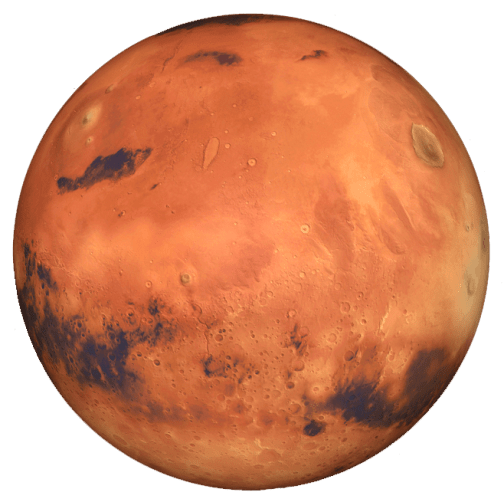
This list obviously wouldn’t be complete without everyone’s favorite red planet, Mars. Mars has long held a fascination, in part due to early observations of channels or canals on the surface (these were later revealed to be the result of an optical illusion). As it turns out, such a reputation might be warranted – Mars is the most Earth-like planet in our Solar System, and shows evidence of being a much warmer, wetter planet in its past (most notably, the presence of dry river networks and lake beds). In the present day, there also appears to be seasonal flows of liquid brine or extremely salty water, most likely the result of salts absorbing water vapor from the atmosphere.

As I mentioned in my previous essay, methane has also been detected in the Martian atmosphere. Since methane isn’t chemically stable under Martian conditions, something must actively producing it. Stranger yet, the production appears to be sporadic, suggesting that this is the result of an active process. While there are purely geological processes that can produce methane, here on Earth, the vast majority of methane is produced by microbes, which obviously raises suspicions.

It’s unlikely the Martian microbes – if they exist – are living on the surface, due to the high flux of radiation. Instead, they’ll most likely be found in deep subsurface habitats or aquifers, or potentially underneath the polar ice caps. Future missions to Mars (notably the ESA’s ExoMars and NASA’s Mars 2020 Rover) will hopefully give us better answers to the age old question of life on Mars.

Europa

Europa.png

Moving into the outer Solar System, Europa is one of the four major moons of Jupiter, and is covered entirely by a thick layer of ice. It’s been a target of great interest to astrobiologists since the data from the Voyager missions suggested the presence of a vast ocean underneath the ice layer. The thickness of the ice shell and the depth of the ocean is subject to debate, but it’s thought that it could be as much as 100 miles deep, and encompass a volume of water twice the size of all of Earth’s oceans. Given the importance of liquid water to life as we know it, this obviously makes it a potential candidate for habitability.

Due to the complete absence of sunlight underneath the ice shell, if there’s life on Europa, it’s probably clustered around hydrothermal vents, much like the vent ecosystems seen on ocean floors here on Earth. These vents are driven by volcanic heating driven by the intense tidal forces of Jupiter, which also keeps the ocean from freezing, and is also most likely responsible for the alleged plumes of water erupting from the surface.

Several missions are planned to study Europa – ESA’s Jupiter Icy Moons Explorer and NASA’s Europa Multi-Flyby Mission, which will hopefully be able to measure the thickness of the ice shell, gather more data on the chemical composition of the surface, and sample the surface plumes (if they exist). Proposals have been circulating to actually drill down and explore the ocean, but such a mission is a while off.

Enceladus

Enceladus.png

Similar to Europa, Enceladus is an ice covered moon orbiting Saturn. It features extensive plumes of water erupting from its southern hemisphere, thought to originate in a subsurface ocean. The exact mechanisms driving the plumes hasn’t been determined, but there’s likely hydrothermal activity in play. Since the plumes are so extensive, the Cassini mission in orbit around Saturn has been able to conveniently sample some of the erupted material, and discovered that it has a high salt content (suggesting hydrothermal activity) and traces of simple organic compounds. Given the presence of organics, liquid water, and a likely energy source, Enceladus has become a hot topic amongst astrobiologists, and will hopefully be the target of future exploration

Titan

Titan.png

Another moon of Saturn, Titan is the second largest moon in the Solar System, and the only one with a dense atmosphere. The atmosphere is made up of a mixture of nitrogen, methane, and a mixture of organic compounds. Titan is a chilly -355 degrees Fahrenheit, so cold that methane is liquid at the surface. In fact, the most interesting thing about Titan is that liquid methane takes the place of water – there are rivers and lakes of the stuff.

Consequently, unlike the other worlds we’ve looked at, if there’s life on Titan, it’s very different from the water-based life we’re familiar with. Potential biochemical pathways have been identified for the Titanian atmosphere, and, interestingly enough, some of the features in Titan’s atmospheric composition would be consistent with presence of metabolizing organisms. Nonetheless, life on Titan remains a much more speculative topic, and will require further exploration of this mysterious, haze shrouded moon.

Conclusion

While Earth may be the most habitable world in our Solar System, it isn’t the only place life might have evolved. No alien life has been conclusively detected, but the hunt is on. The most exciting aspect of this search is that if life evolved independently, multiple times within the same solar system, it suggests that the emergence of life is a common event.

In other words, if we discover that our Solar System is teeming with life, it’s likely that so is the rest of the galaxy.


Tess

Tessa is a 28 year old PhD student, and perhaps the world’s only queer trans astrobiologist. A nerd going way back, her interests include science fiction, space exploration, sustainability, science communication, and feminism and gender. Her hobbies also include horseback riding, playing the flute, social dancing, knitting, and occasional attempts at writing fiction. She currently resides in Tempe, AZ with her even nerdier fiancee and a mastiff mix who thinks he’s a lapdog. She tweets occasionally @spacermase.

Get Excited for Steampunk!

So I’m a bit of a Steampunk nerd. I love the style: the Victorian dress with funky gadgets made of brass and way too many cogs and gears, adventure and intrigue, the science…the whole 20,000 leagues! Get it? Anyway…

Steampunk is a subgenre of science fiction with a massive following. The term “steampunk” was coined in the 80’s, but the genre started back in the Victorian era with writers like Jules Verne and HG Wells. Back then, it was used as a glimpse into the future. A possibility. Now, Steampunk is a look into an alternate history.

Still, despite its interesting culture and growing favor, the genre has a small film base. The list includes films like Hugo, Wild Wild West, and the Golden Compass, as well as a number of European films like The Extraordinary Adventures of Adèle Blanc-Sec. Wikepedia lists only 30 films total, and of that list I’ve personally only seen three! I’d never even heard of most of these and the some of the ones I have seen, such as Van Helsing, did not strike me as being part of the Steampunk genre. But I digress…

Hugo2
Gears! Robots! What more could you ask for?

The point is that the genre itself has a lot of potential! And StudioCanal in France as well as a few Disney animation veterans seem to see this as well.

This year come spring time, StudioCanal is releasing an animated film called April and the Extraordinary World in French. It’s a 2D animation with an art style that feels reminiscent of Hayao Myazaki (at least that’s what I gather from the images I’ve seen). The film has already previewed last year at the Annecy Film Festival at which it received an award for Best feature film. From what I’ve gathered, the film does not appear to be releasing in the US, but rather Canada. It’s not very clear. But don’t sweat it just yet, as there’s always the DVD release. Or Netflix.

Also on it’s way is another 2D animation film called Hullabaloo! Imagined by Veteran Disney animators who believe that 2D art as an animation medium is on the decline, Hullabaloo is expected to give us all the fun and adventure of a Disney movie: Strong female characters, great orchestral music, and an enchanting story. Sadly, the film has no release date yet. Even more sad, the project is being funded through Indiegogo. But that is where the sadness ends. The group working on the project started the crowdfunding campaign to fund a short film to pitch to a studio that would then (hopefully) fund a full length feature film. Currently they’ve raised enough to make that short film, and three others! I don’t know about you, but I’m starting to think there might be a desire out there to see more steampunk on the big screen! One can only hope.

Personally, I find what the animators from Disney are doing to be admiral. Fingers crossed that when Hullabaloo does get released (and I’m sure it will one way or another) that people remember the beauty behind 2D animation. It’s an art form I think we would miss down the line. Plus it’s totally fitting, Steampunk is a revival of the aesthetic of the Victorian era. Hullabaloo wants to start a revival of 2D animation.

In the meantime, I think I’m going to hunt down some of these films I’ve never heard of!

If you want to know more about the films, you can check out Hullabaloo’s Indiegogo page and this article on Alice and the Extraordinary World. The world of Steampunk awaits you!


Rose

Rose is a casual nerd who has been writing since she was able to form words. She loves anime and anything cute and fuzzy. She’s a casual gamer who plays all her games on the easiest possible setting and still gets terribly stuck. She’s a fan of Disney movies, theatre, superheroes, Star Wars and Star Trek, and making things from other things because making things from scratch is too hard.

24 Miscommunication- Some Nerd Girl Original Webcomic

Introverted subtext: “I am enjoying this movie alone!”

Check out all the SNGCs here and join us every Monday for a new original SNG Webcomic!


AlexAlex is our resident Webcomic creator. He grew up in Puerto Rico, but didn’t reach true Nerdom until he came state side when he was in middle school. He’s been drawing since he was five, but has only started posting Webcomics in the past year. You can check out his amazing and original work at tapastic.com/gomezalexj.

The Professional Nerd’s Guide to Climate Change

What is Climate Change?

It’s the thing that everyone is talking about. It’s a thing that some politicians don’t “believe in”. It’s something about Noah Wyle and polar bears, about SUVs and Priuses, Republicans and Democrats. So what is it, really?

First, it’s important to understand the difference between climate and weather. According to Dictionary.com, weather is defined as “the state of the atmosphere with respect to wind, temperature, cloudiness, moisture, pressure, etc.” Weather is what it’s like out now. Climate, on the other hand, is long term weather. It is the average moisture and temperature of a region averaged out over many years. When we talk about Climate Change, we are not talking about that 60-degree Christmas we just had, or that really, really, cold day a few weeks ago where you had to wear long underwear under your jeans.

The temperature has increased 0.8oC (1.6oF) since 1880 (NASA). The climate is changing, faster in the last 50 years than in recorded history, and scientists expect another couple of degree rise in average global temperatures in the next 100 years (NRDC).

You may be asking, Is this the same thing as Global Warming? Yes. Well, kind of. Global Warming is a more simplified term that refers to this average temperature increase, but doesn’t take into account the fact that a few very small areas have gotten a little bit colder, and that there are also significant effects on precipitation. This picture from NASA shows how most of the Earth has gotten warmer, except for a few isolated areas.

ClimateChange1.png

What causes Climate Change?

According to the Columbia University webpage, carbon dioxide is the big player in Climate Change (but also has other vital roles in the environment, including allowing plants to create food for us to eat and oxygen for us to breathe).

All day, every day, and all night, the sun is radiating waves of all types, including visible light and ultraviolet light, to the Earth. Fortunately for us and for our skin, the atmosphere protects us from the majority of ultraviolet and other dangerous waves.

Most of the sun’s waves are absorbed by the Earth, and then radiated back out as slightly weaker waves. These slightly weaker waves, in the form of heat energy, are not powerful enough to escape through the atmosphere, and thus are trapped by greenhouse gases such as carbon dioxide inside the atmosphere. This has the effect of heating up the Earth, much like a greenhouse or a car becomes hotter than the outside air on a cool day.

Why should we care?

It will get a little bit warmer. There will be more heat waves, so heat-related illness will increase. Diseases that are spread by warm-weather species, like mosquitos, will spread faster and more easily.

According to the Natural Resource Defense Council, there will be more major weather disasters. Not only will there be more wildfires, but there will also be more floods and droughts. Disastrous (and expensive) hurricanes and snowstorms will occur more frequently (and already have, in the last decade).

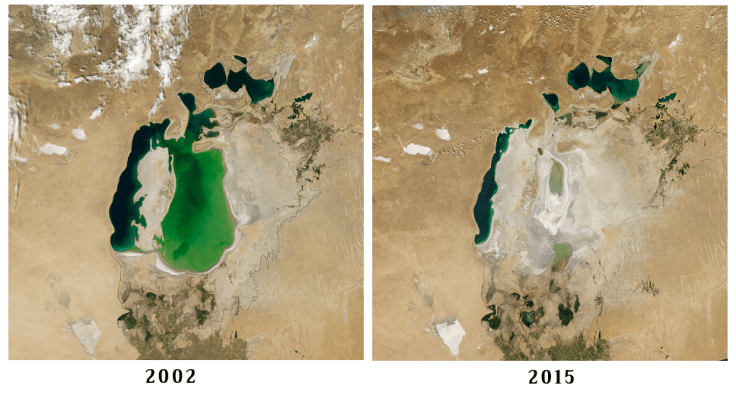
National Geographic has a great article showing before and after pictures, including the picture below of the 4th largest lake in the world, which many people rely on for drinking water, shrinking in the last 14 years.

ClimateChange2.png

Lastly, we’ve all heard that glaciers are melting. At this rate, all glaciers in Glacier National Park will have melted by 2070. This is hugely problematic if you are a polar bear or other arctic species, but also if you live at or near sea level where all of this melted water will end up flooding.

Wait, we’re not responsible for this, are we?

Actually, yeah. We are. 97% of climate scientists agree that human activities are contributing to Climate Change. Any time gasoline, natural gas, oil, or coal is burned, carbon dioxide is released. Whenever plastic is made, carbon dioxide is released. When a cow burps, methane is released and also contributes to the problem.

ClimateChange3.png

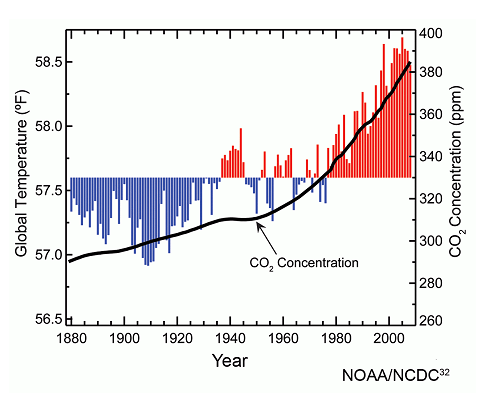
The graph below shows how the average temperature has changed in the last 130 years, and how the amount of carbon dioxide in the atmosphere has increased comparatively.

ClimateChange4.png

But, if you think back to everything you learned on Earth Day in 4th grade, you can actually help prevent further damage. Carpool more, drive a Prius, and turn off the lights when you leave the room. That will help, a little. What we really need is to significantly limit the use of petroleum products, which release carbon dioxide into the atmosphere. We need significant improvements in cleaner energy sources, such as nuclear, solar, and wind power, to make these technologies efficient and cheap enough to be practical alternatives to petroleum. We need more research, more innovation.

What are you going to do to help?

Who have I cited and why?

I feel strongly that any statement masquerading as fact should have a source that is a peer-reviewed journal or a government or non-profit organization that provides link to peer-reviewed journals. As for why, that requires a longer lesson on controlled experiments and sample sizes. We’ll save that for next time.


RobinRobin has been a professional nerd since 2011; that is, she is a 7th grade science teacher. She loves reading and watching science fiction and is working on creating her own young adult fantasy series. She prefers Star Trek to Star Wars because she enjoys the plot-driven social commentary, rather than fast-paced action sequences. She enjoys video games, but only those with graphic technology prior to 2003 because anything newer makes her dizzy.


Create a free website or blog at WordPress.com.

Up ↑