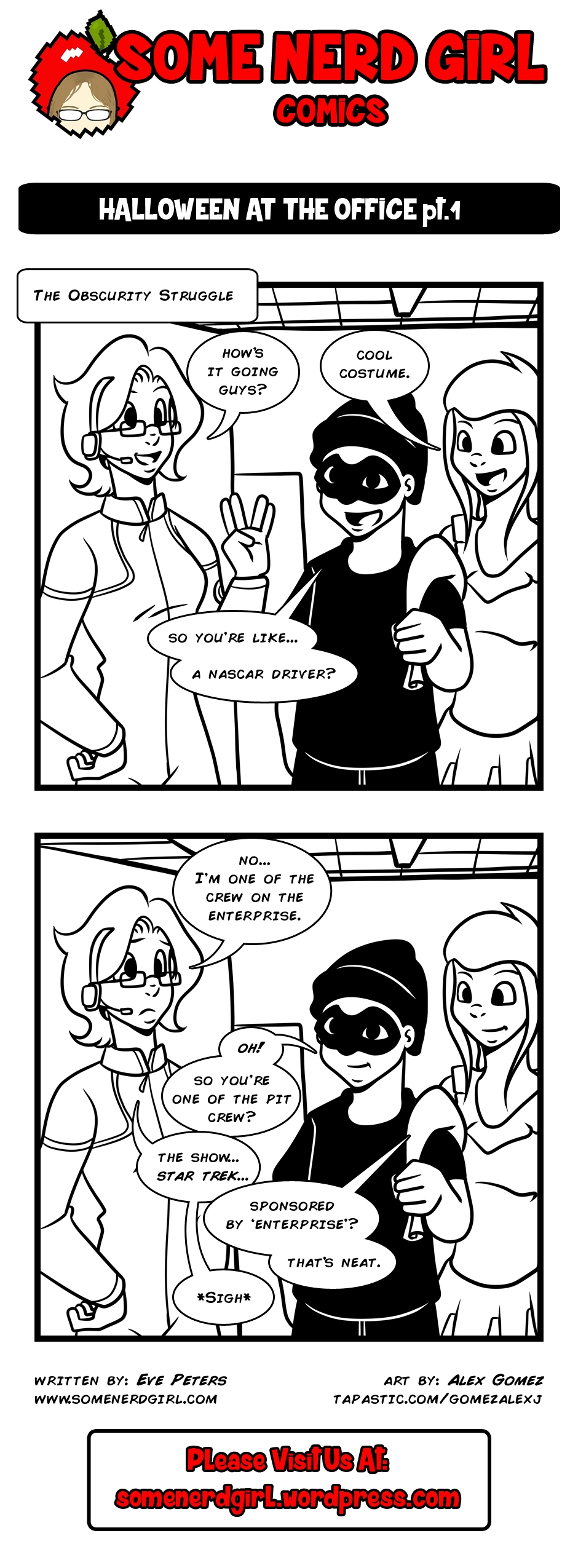
Being a nerd means you are basically never recognizable during Halloween. I’ve made my choice, and I accept my fate!
Join us every Monday for a new, original Some Nerd Girl Webcomic!
Alex is our resident Webcomic creator. He grew up in Puerto Rico, but didn’t reach true Nerdom until he came state side when he was in middle school. He’s been drawing since he was five, but has only started posting Webcomics in the past year. You can check out his amazing and original work at tapastic.com/gomezalexj.
Our first 10,000 views are in the books – now here’s to the next 10k!! But before that, we have some great news for three lucky winners of our 10k Views Giveaway!
To celebrate the blog’s10,000th view, we gave away a $25 gift card to ThinkGeek.com, and SNG founder’s original signed novels: Children of the Fallen and Colony One.
Winners are announced in the video below and will be contacted via email to arrange the delivery of their prizes!
Thanks to everyone who entered, more giveaways are in the future!
Also, thanks YouTube for the really awesome… amazing, and might I add…. stunning – YouTube video still.
‘Looking Skywards’ is part of a multi-post series where the writers of Some Nerd Girl share their Origin Stories – in other words, when and how did the nerdening happen?!
It’s hard to say when I first became a nerd. My earliest memories include my mom reading me J.R.R. Tolkein’s Letters to Father Christmas, and, later, excerpts from Anne McCaffrey’s The Dragonriders of Pern series. I’ve always been fascinated with the natural world, and was a pretty outdoorsy kid. And from an early age I loved stargazing. However, even if I can’t narrow my entry to nerdom specifically, there are a few discrete events that definitely set me on my current path.
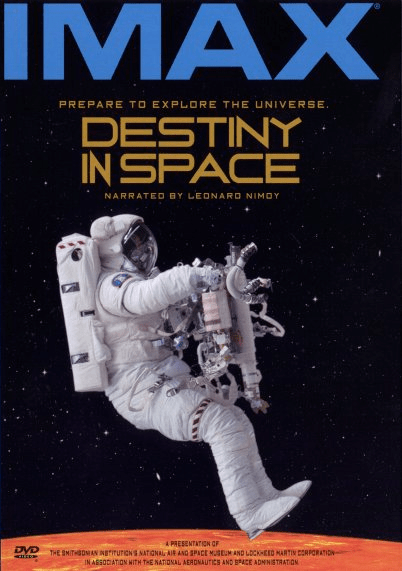
The first one I can think of is when I was 7 or so, my parents took me to the Smithsonian National Air and Space Museum in D.C. At some point during that trip, they decided to treat my twin brother and I to a showing at the IMAX theater. The film we saw was a documentary narrated by none other than Leonard Nimoy, entitled Destiny in Space.
To be honest, the film actually hasn’t aged all that well, but at the time, the imagery absolutely captivated me. Soaring over the newly radar-mapped terrain of Venus. Watching Mars become slowly more Earth-like as it was terraformed. Astronauts spacewalking above the surface of the Earth. From that point on, I had been bitten by the space bug, and I got it bad.
A few years later, at a Scholastic Bookfair (remember those?) my brother picked up a beautiful illustrated paperback, entitled Extraterrestrial: A Field Guide for Earthlings. It was the first book I had ever come across that presented the possibility of alien life as a serious scientific topic. It imagined how actual extraterrestrial lifeforms might evolve under a variety of environmental conditions, what sense organs they might use, possible body layouts, and even speculated on more radical forms of life that we might not even initially recognize. While it didn’t seem like as a big of idea at the time, the idea that aliens were a concept that could be seriously addressed scientifically stuck with me.
Although this guy doesn’t help at all.
As I hit middle school, I became increasingly interested in the sciences. Unsurprisingly, I also got more into science fiction, as well. After cutting my teeth on my mom’s old Andre Norton and Anne McCaffrey paperbacks (guess where I got my scifi gene from?), I started exploring the science fiction and fantasy section of the local library. First, I read mostly McCaffrey, but soon serendipitous discoveries lead me to other authors. The cover of Ringworld intrigued me, and introduced me to Larry Niven, who’s hard science fiction I devoured (I was particularly fond of the Known Space series). Via The Moon is a Harsh Mistress, I discovered Robert Heinlein, though I found a lot of his writings a bit more difficult to get into (I did slog through most of I Will Fear No Evil, but I had additional motivation). Later my list of favorite authors would include Alfred Bester, Rodger Zelanzy, Neal Stephenson, Lois McMaster Bujold (who’s Vorkosigan Saga is one of my current favorites), Connie Willis, Ursula K. LeGuin, and Neil Gaiman.
So… much… great… sci fi!
Also, as an aside, I became a massive band geek, and would later have the distinction of being That One Guy in the Piccolo Section, but that’s another story for another day.
As I made it into high school, naturally I began to think about college and careers. Unsurprisingly, I looked at space-related careers – considering being perhaps an astronomer or astrophysicist, or maybe an aerospace engineer. I would later back down from both of those careers as, at the time, I thought they’d be too math intensive for me (ironically, my actual work now is focused pretty much exclusively on mathematical modeling). In any case, the question was somewhat incidental – from age 12 onward, I knew what I really wanted to do was be an astronaut – but I figured I should at least have some options.
However, towards the end of high school, I somehow stumbled upon a new and upcoming field of study: astrobiology, the study of the origin, evolution, and distribution of life throughout the universe, including beyond Earth. While I was still fascinated with studying life beyond Earth from a scientific point of view, I had no idea that this was a real area of study, with NASA support and everything. I suddenly knew what I wanted to do with my life.
This. Changes. Everything!
In college, wanting to cover all my bases, I double majored in astronomy and biology, and did my senior paper for my astronomy degree on the possibility of biosignatures on Mars. During the summer before my senior year, I also got the opportunity to intern at NASA, analyzing images of Jupiter’s moon Europa from the Hubble Space Telescope; to date, that experience remains the best summer job I’ve ever had.
Recognize! Yes, I was geeking out a little!
At some point, I went to a talk given by former astronaut Kathy Thornton, who mentioned off-hand that having a terminal degree (e.g., a PhD or an M.D.) was a requirement to have a serious chance of being selected into the astronaut corps. While I don’t want to say this single-handedly persuaded me to go to grad school, it certainly sealed the deal.
I eventually located a graduate school that had an astrobiology lab (there are about a dozen universities in the U.S. that are involved in astrobiology research), though, ironically, rather than astronomy or biology, it was actually housed in the geology and environmental science departments. I got my first chance to do real scientific research – the topic I eventually focused on was using mathematical modeling to help understand microbial ecosystems that exist in extreme environments (underneath glaciers, in hot springs, and so forth). The hope is to use these models to try to characterize what constitutes a habitable environment for life (for example, if we find microbial communities underneath the ice sheets of Antarctica, is it possible similar communities exist underneath the polar cap of Mars), and what sorts of detectable effects those ecosystems have on their environments (this may sound dry, but it isn’t; my master’s thesis involved this place).
Here I am, doing science-y stuff!
At the moment, I’m currently working on my PhD in the subject. My dream job is to be a researcher for NASA, being on the cutting edge in our search for life throughout our Solar System. Following this path has allowed me to embrace my nerdiness to new levels, turning a passion into a career (and if you think cons are nerdy, wait until you experience a science conference). I’ve gone from reading science fiction to pretty much living it (I’m a gender-changing scientist who hunts for aliens- tell me my life isn’t the plot of a New Wave scifi story from the early ’70s). And I’m sure there’s even greater heights of nerdiness awaiting me on my journey.
And for the record, no matter what, I still fully intend to become an astronaut.
Tessa is a 28 year old PhD student, and perhaps the world’s only queer trans astrobiologist. A nerd going way back, her interests include science fiction, space exploration, sustainability, science communication, and feminism and gender. Her hobbies also include horseback riding, playing the flute, social dancing, knitting, and occasional attempts at writing fiction. She currently resides in Tempe, AZ with her even nerdier fiancee and a mastiff mix who thinks he’s a lapdog. She tweets occasionally @spacermase.
At their core, pop culture conventions are meant to be lighthearted, fun events where people with similar interests can meet like-minded people and embrace their nerdy sides. I can honestly say that on a good convention day, I wouldn’t rather be anywhere else. But conventions and the culture surrounding them have an ugly dark side, one that terrorizes women and men alike and thrives off of sexism. Cosplayers are groped, con-goers are attacked, and people are stalked, screamed at, and flamed. There’s an elephant out on the convention floor, and its sexual harassment.
Who’s your favorite female video character? What about your top ten favorites? How many of those female characters display ludicrous amounts of cleavage, ass, or legs?
The answer is gonna be ‘most of them.’
Now, look up some cosplays of those characters, and read the comments. Take a shot every time you read a comment vilifying the cosplayer for wearing that same outfit. Finish your drink if you see “Slut” or “Whore”. Annnd now you’re dead.
On the con floor, many female cosplayers are cat-called, groped, and generally meant to feel unwelcome. Even outside conventions, cosplayers who choose to make replicas of the sexy costumes of their favorite characters face vitriol and gross harassment. On social media, female cosplayers are accused of being attention or actual whores for daring to show cleavage accurate to a character’s design. A design meant to pander to males in the first place. And even though women face the brunt of the problem, it’s not just men who are harassers. While less known, there are reports of ladies acting inappropriately with male cosplayers as well.
These guys could probably tell you all about it.
And if you’re thinking, ‘well why would they wear such revealing outfits they don’t want attention?’ ask yourself this. What sort of attention are cosplayers looking for?
There’s a lot I love about wearing a costume to a convention. I love seeing people’s eyes light up when they spot their favorite character, I love when people ask my permission to take pictures of a cosplay I’m proud of, I love when people high-five me and I admit, I do enjoy the compliments I get on my look. These are the forms of attention I hope for when I cosplay.When I’m getting ready for a con I put on my cosplay and I think ‘I hope other people enjoy this!’ I don’t put on my cosplay and think, ‘gee, I sure hope this gets people to violate me.’
Sexual harassment isn’t just limited to cosplayers either. Five years ago I was molested at a convention. It was my first big convention, and I’d changed out of my cosplay back into street clothes to go to a dance the con held. He was handsome, confident, and grown up, and I was fourteen, naïve and too young to understand the way he’d looked at me – too young to know that grown men don’t ask little girls to ‘dance’ with them. My story was not as isolated incident either, and I’ve heard many similar stories of young girls at conventions being taken advantage of by predators.
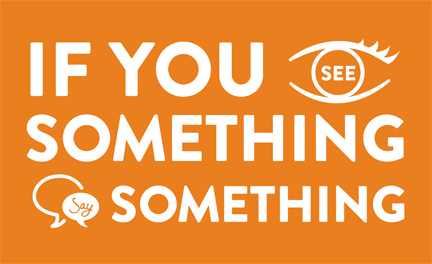
Where is this for conventions??
Three years after the incident I returned to the convention where I’d been assaulted, and almost as soon as I walked in my attention was caught by a booth run by young women who seemed to be handing out little decks of cards.
“We’re trying to raise awareness and help stop sexual harassment of cosplayers and con-goers.” One of the girls told me, energized, but gentle too. “Have you ever experienced sexual harassment at a convention?”
I bowed my head and mumbled yes, and the woman handed me a deck of colorful laminated cards. “Take these.” She said. I read the cards over.
“What you just did was harassment.” The red card said. “You have grossly stepped over the boundary of acceptable social communication.”
The yellow card was somewhat kinder. “What you just did was harassment.” It read. “Maybe you didn’t realize. In the future, think harder about the way your actions may be perceived.”
The only card I hoped I had to use was the green one. “You stepped in to help stop harassment.” It read. “Thank you.”
It brought me back to the people I saw four years ago; the people who saw me. What I remembered most about that horrible day wasn’t his hands tangled up in the hair hanging at my hips, but the people who looked at us and laughed as they passed me by, as if my gross violation were just an inside joke between them and the convention.
And maybe it was, at least at the time. But I truly believe that things are changing now. Sexual harassment is still a far-too-common problem in convention and cosplay culture, but the difference is that by now, people have noticed. Sexual harassment at conventions is no longer the shameful secret it once was. More articles are being written, more videos being filmed, more booths run, more outrage and cries for change. People are infinitely more aware of the fact that sexual harassment is a problem at conventions, and with that awareness comes change.
So simple, but you have no idea what a difference it can make.
I don’t know if I’ll ever feel safe enough to go to a convention by myself again, but at least I can say that with the increased awareness of sexual harassment, conventions feel like places to have fun again. That booth that gave me hope last year wasn’t tucked into a dark corner, but set up so it would be impossible to ignore, and that alone displays a huge shift in the way sexual harassment is approached now. Sexual harassment is no longer an issue con-goers snicker at, and if we continue to call attention to the issue, then perhaps those who thrived under the shadow of shame and ignorance will find that they no longer have the cover they need to hide their wrongs.
I would love to see situations where I’d be able to use that green card those amazing women gave me, and I would like to personally ask any fellow con-goers reading this article to keep an eye out for harassment. Stopping sexual harassment can be as easy as stepping in and asking what’s going on, and the worst that could happen is that it was a misunderstanding and everyone is fine. Don’t be afraid to speak out and up! You may just become someone’s real-life hero.
Rebecca is the daughter of two Mexican immigrants who lovingly support her nerdier hobbies. She is a cosplayer, con-goer, anime lover and lifelong writer who’s had several short pieces of fiction and poetry published under her very long name. She has also recently finished writing her first novel, a young adult adventure book with LGBT characters. She is a new college student and is currently majoring in biomedical engineering.
 Alex is our resident Webcomic creator. He grew up in Puerto Rico, but didn’t reach true Nerdom until he came state side when he was in middle school. He’s been drawing since he was five, but has only started posting Webcomics in the past year. You can check out his amazing and original work at tapastic.com/gomezalexj.








 Some Nerd Girl

Recent Comments